
Small Victories
In this time of deep division

A Jar of Custard
I want to write about last weekend’s murders and shootings in my new home state of Minnesota, but I can’t without first telling you something about Chinquapin Mountain in western North Carolina. This is the mountain where I want to take my grief. My body doesn’t understand that I can’t go there. I suspect I will always find it disorienting to leave the city and encounter miles of midwestern farmland. Something inside of me will always expect to drive straight into the Appalachians.
My father-in-law introduced me to Chinquapin Mountain. He wasn’t yet my father-in-law, and I didn’t yet understand that his body looked exactly like my husband’s body. He said, “This is my training hike,” meaning that the short, steep hike up Chinquapin was how he acclimated his Coastal Plain legs and lungs for longer, higher hikes in the area. Sometime in the 1970s, his parents had built a house in western North Carolina as an escape from south Georgia’s sweltering summers.
When my father-in-law was diagnosed with Creutzfeldt Jacobson Disease—commonly known as Mad Cow Disease—we waited for a different diagnosis to emerge. It wasn’t that we didn’t believe he could die, it was that what he was going to die from was the stuff of clickbait and conspiracy theories. When he was diagnosed, his neurologist suggested we keep his diagnosis quiet in order to avoid becoming a blip in a news cycle.
But it was the early 2000s, and my father-in-law was from a smallish place where two old men who remembered how much he’d loved custard as a boy delivered mason jars full of it to the front porch.
When I read advice about coming to know one’s neighbors as a defense against rising fascism, I think of those old men and their jars of custard.
It was while caring for my father-in-law on home hospice that I saw his body was my husband’s body. I mean exactly. Observations such as these defy understanding as you watch a body die. My son has my body, dense and square, which means he and I have my father’s body, and it pains me to write those words because they don’t change mortality.
While my father-in-law was dying from Mad Cow Disease, I took my son on a walk along a weathered boardwalk through a swamp. We were looking for alligators and “catfaces,” which is the name for the mark left on pine trees by turpentining. We found both. And then, as we neared the place where the boardwalk stops at a small pond, we heard a wild screaming. In our matching bodies we began to run toward the sound. I wanted to see the source before it passed out of sight, and I suppose my son did too.
On the far side of the pond there was a rookery. I identified the birds as the cranes I’d seen in Japanese art, that iconic bird with the slash of red flying in front a white disc moon. Hundreds of them, huge in the trees, their paler feathers sharp as pearl in the late slanting sun. We were grieving deeply, and happening upon the creatures of Japanese art in a south Georgia swamp was like taking a step sideways into a more ordered reality. My sense of being a part of something vast and structured toward goodness wasn’t dulled when I learned that these weren’t the red-crowned cranes of Japanese art but the sandhill cranes of North America.

In her essay “In Spight of Prisons,” Helen Macdonald writes, “It is hard in these days of ecological ruination to find way to reconnect people to a natural world more commonly encountered on television and video than in its living reality.” She’s writing of the wonder of glow-worms, but her sentiment applies to the wonder of a crane colony. I am part of the natural world too, and so are you. That’s why we die from things like Mad Cow Disease. That’s also why we connect to something vast and ordered not only through cranes but also through the marvel of someone showing up with a jar of custard. We can choose to show another how together we fit into the larger structure of goodness.
The man who killed state Representative Melissa Hortman and her husband, Mark, and wounded state Senator John Hoffman and his wife, Yvette, modeled the opposite of the human capacity for goodness with his decisions.
Good-bye to the Training Hike
Before moving to Minnesota, my husband and I said good-bye to Chinquapin. When we got out of the car, the late afternoon sky was filled with passing birds. They were too high for us to identify, but we could tell that they were mostly raptors of a single type. A few larger and smaller raptors flew with them as well, along with a handful of songbirds. We didn’t know what we were witnessing. It was magical. It was also ominous, like those movie scenes where the animals stampede out of the forest ahead of the catastrophe.
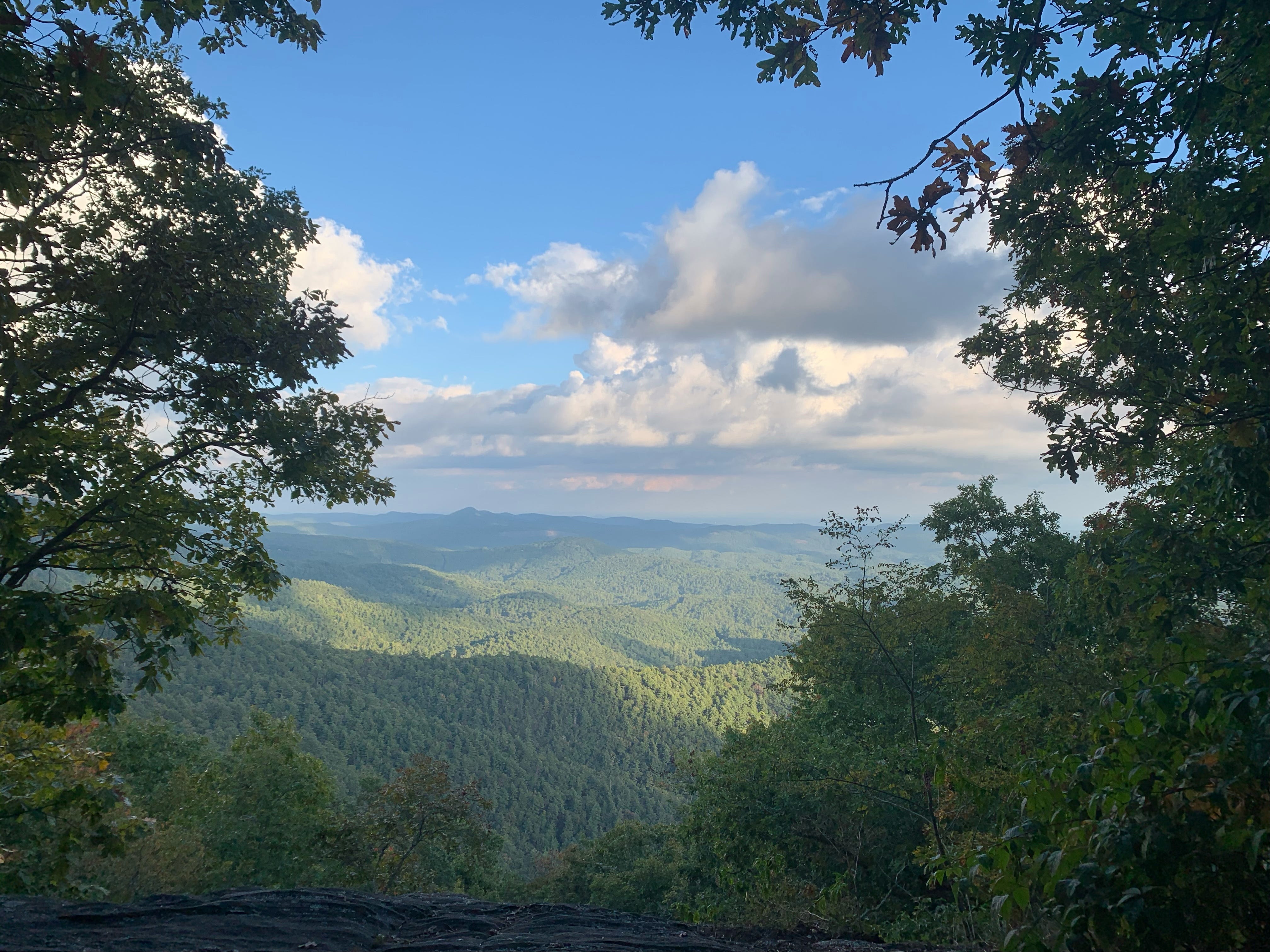
Later, once we’d left the mountain and regained cell reception, we learned that broad-winged hawks migrate. It felt as if our training hike said good-bye to us even as we said good-bye to it, reminding us of how much we still did not know, of all of the ways we could still be surprised.
Recently, on the way to a new friend’s house, I saw a pair of sandhill cranes on the side of the interstate. This pair looked much grayer than the birds in my rookery memory. One gently nuzzled the other, which surprised me, and then I was surprised by my surprise: I expected these birds to care about the roadway as much as I did. What a relief it is to report that I remain little more than background noise in the life of two sandhill cranes.
On my way back to St. Paul, I swung by a farm stand my new friend told me about. In the tiny shop I bought vegetables and jam and meat grown on the surrounding acres, and I paid for it on honor using my Venmo account.
What I Want to Protect
I’m fiercely interested in protecting that honor system farm stand, the private lives of those cranes, all of the migrating hawks, and a world where old men make custard for a dying middle-aged man who, to them, is still a boy. I want to protect the wild world, human kindness, and acts of trust.
Most of the conversations I have with folks lately include discussion of how to protect the things we care about. My work is storytelling, so I tend toward reclamation of our personal narratives as a starting point.
The deepest terror in my body involves white men with Christian Nationalist type viewpoints. These men hate women but believe that they protect women. They hate anyone who isn’t white but believe their hate is justified because they think white skinned folks are under attack. They hate all iterations of gender and sexuality except for straight men such as they perceive themselves to be and straight women who mirror their desired version of masculinity back to them. They believe that America belongs to them. They believe that God is on their side in all of these beliefs. They have positioned themselves as defenders of a better world and armed themselves in preparation for this role.
This terror is one of the reasons I welcomed the move to Minnesota. My body may never understand why I don’t enter the Appalachians when I drive out of the city. This is a new grief. It replaces a fear state so constant I’d not understood it was a feeling. I thought the sensation was just part of my body. I’m not sure if I felt this fear more in the Southeast because there is more reason to be afraid there or if it’s simply that this is where I had experiences that taught me to fear people with these beliefs.
I wept with the murderer’s roommate, David Carlson, as he struggled to read aloud the text he’d received. These men had been friends since they were boys. I believe that David Carlson knew nothing of his friend’s plans. Had his friend told him what he planned to do, I believe that David would’ve said, “Don’t. I’ve known you a long time. You’re better than this. There is goodness in you that you’ve forgotten.” I believe this because of how David wept. I believe this because to do so is to add a little reinforcement to the structure of goodness in which humans can choose to participate.
No Kings
I was so afraid that I almost didn’t walk from my home to downtown St. Paul to attend Saturday’s No King rally. The man who killed state Representative Melissa Hortman and her husband, Mark, and wounded state Senator John Hoffman and his wife, Yvette, is an iteration of the scariest monster in my head. I feared he was part of an organized group. I imagined a mob similar to the people who stormed the Capitol on January 6, 2021.
My father-in-law was not a Christian Nationalist. That’s not why I wrote of him. Rather, just as he died from a disease that is both real and also the stuff of sensational conspiracy theories, so might I encounter a group of murderous Christian Nationalists. Or so might all of us come to live under the fully realized vision of Project 2025. These are reasonable fears that are heightened inside of my own body because of experience and memory.
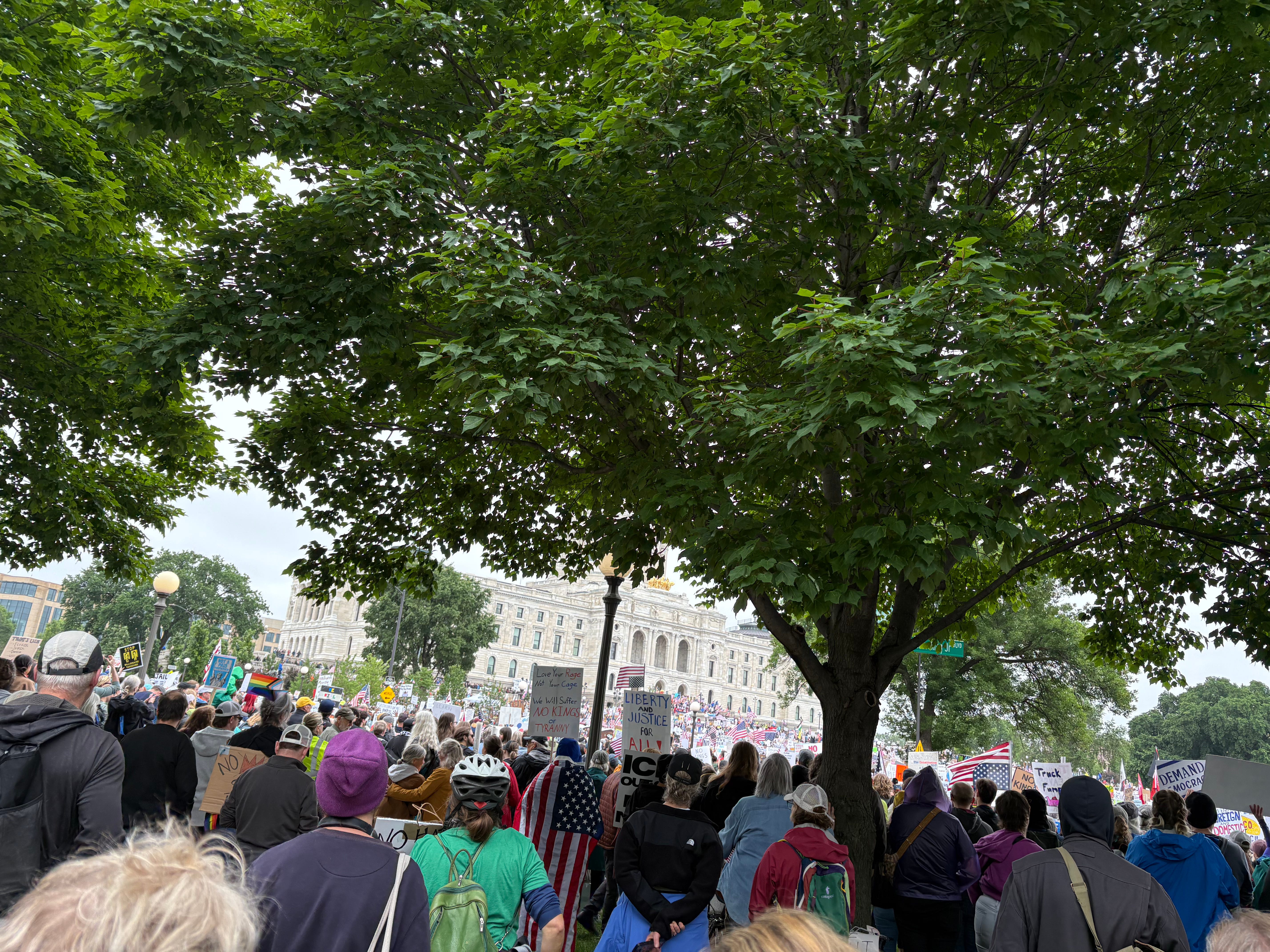
I also know from experience and memory that joining a well-organized Indivisible rally is usually a small and easy contribution to the way I’d like the future to be. There are often even porta-potties on site. And so I went, and the experience was as healing as my memory told me it could be, and as a result I am a little less likely to hate my fellow humans who I feel most closely resemble the monsters in my head.
This is a small victory. Small victories are how our personal narratives are rewritten. Small victories are one way we protect all that is worth protecting.
The Minnesota shootings affected me very deeply as well, Ginger. Thinking of you, holding you dear.
Beautifully articulated, as is your gift. Sending much love your way.