
For the Helpers, 1.4
And all others who, like Governor Walz and me, are “cautiously optimistic”

Dear KTC,
We have more new members in our group. Welcome!
Perhaps there will be a need for a fuller get-to-know-me post one day, but for the current purposes of this newsletter it seems enough to identify as a recent Minnesotan (17 months) by way of half a life in Georgia. I was raised to become a white Christian nationalist. I’ve never been one. This isn’t a how-I-got-out space.
Neither is this an us-vs-them space. Most, perhaps all, of my extended family have been brainwashed into the cult of MAGA. Relatives who voted for Jimmy Carter now turn a blind eye to federal mercenaries racially profiling and abducting people from the streets. This sort of shift isn’t unusual in present day America unfortunately. This is how we’ve ended up with a second Trump presidency. Thus far, the most helpful single source I’ve found for understanding how this happened is the memoir On Fire for God by Josiah Hesse.
Currently my family and I are in a phase of limited contact. This happens a lot in families like ours. But the larger goal of both my continued relationship with my bloodkin and of this newsletter is unity. I have more in common with any MAGA supporter I know than I do with Trump. If you identify as MAGA and you’re reading this, you have more in common with me than you do with our president.
Only the billionaires benefit when everyday people like us agree that this is an us-vs-them moment. It’s actually a people-vs-billionaires moment. In fact, people-vs-billionaires is one of the meanings behind the protest chants, “Who keeps us safe? We keep us safe!” and “Whose streets? Our streets!”
So welcome. I’m glad you’re here. These are our streets. Thanks for showing up and helping out.
Stick to the first half of this letter if you’re having a tough week. Read the second half if you’re feeling well resourced.
Please use this as a tool to strengthen and build your communities.
I love you all so much.
The Easier Stuff
Here are three ways to help this week:
1. From your phone
Let’s use 5 Calls and call our two US Senators and our two US Senate leaders and ask them to oppose the SAVE Act. This passed the House on February 11th. This act will eliminate mail-in voting and allow the DHS to seize voter rolls. The increased scrutiny on citizenship documents has the potential to disenfranchise millions of voters who were born in the US and have changed their surnames. While this group isn’t only married women, they (we!) constitute the majority.
2. With your wallet
This week’s nonprofit was sent to me by my friend, Pat Koppa. I know Pat as a fellow writer whose forthcoming book on thriving with chronic illness is one to anticipate. Her father gifted her a kidney when she was in her early twenties, and this kidney, Cyaticus, turns 100 this July. She’s one of our planet’s longest living transplant recipients. I listen when she tells me that gratitude and compassion are keys to longevity.
Restaurants across Minnesota, especially immigrant-owned restaurants in the Twin Cities, are suffering under the federal occupation. The Salt Cure Restaurant Recovery Fund was started in late January “to help preserve the heart of Minnesota's food culture, serving those that serve us.” You can read more here, and you can donate here.
If there’s a fund that you would like to see mentioned here, please let me know. I’d not heard of this one until Patty shared it. There’s so much need right now.
3. With your kids
Recently a neighbor shared a link to Doing Good Together, “a Minnesota-based national nonprofit that works to make volunteering and service, along with daily kindness, easy for every family.”
There are many ideas and opportunities on the DGT website. I’m so encouraged by their mission statement that I want to share it in full:
In a culture that so often appears to reward materialism and greed, practicing kindness and serving others as a family is a powerful way to pass on the values of empathy, thoughtfulness, and social responsibility. But its benefits go beyond growing compassionate, engaged kids.
When we intentionally focus on “giving back,” we address real, immediate community needs; bring joy, longevity and health benefits to our families; and create hope for the planet’s future by instilling the spirit of giving in a new generation.
Thank you to those who sent along a big box of books, puzzles, and letters of support. A neighbor distributed these among a group of families who are sheltering in place. The children range in age from two to sixteen. There’s a recipient for each item you sent.
This week’s joyful thought is from my friend Moonrabbit. She’s Minnesotan born and bred, a Jewish astrologer who offers Death Charts, a mom, a wife, a lesbian, a writer, a twin, and more. Each time I’ve seen her since the occupation began, Moon has said, “The primary edict of Judaism is ‘Tikkun Olam,’ —to heal a broken world.”
The Tougher Stuff
1. Preparing your community
Imagine that ICE occupies your city and suddenly many folks are afraid to leave their homes or go to work. You and your Supper Club quickly collect a few thousand dollars for rent assistance. The questions begin! Who decides who you will assist? How will you identify those who need assistance? How will you distribute funds?
If your Supper Club is the type to collect funds for others, this could be a conversation to have over dinner one night. You could even consider creating a structure to navigate such a situation. Here are some ideas. Think of these as the do-good siblings to the shell company.
2. Seeking defectors
Many readers of this newsletter either voted for our current president or have loved ones who identify as MAGA. If you voted for our current president, I hope the information in this section will give you new tools for evaluating the MAGA movement. If you have loved ones who identify as MAGA, I hope this section will enable you to have more meaningful conversations with them as we move toward the 2026 mid-terms.
This week, I’d thought to continue our discussion of news sources, but then I was asked what gives me the right to write this newsletter. This is an excellent question! This is exactly the question we should each ask each time someone presents as an expert: what gives you the right?
Mostly, I’m not qualified to do the things you need doing. I know this is true because here are a few things I’ve asked others to do for me in just the past few months: repair a leaking shower; repair a damaged ceiling; install handrails; install a window; service my boiler; prepare my family’s taxes; give me a decent haircut; clean my teeth; remove my uterus; determine my eyeglass prescription; make my new eyeglasses; fit my new eyeglasses; lead me through a yoga class; offer PT for my back pain; help me sell a house; help me buy a house; teach me Spanish.
People have also provided expertise to me in ways that are simply woven into the fabric of our daily lives. For example, someone grew the apple I’m eating, someone harvested it, someone packaged it for shipping, someone drove it across the country, someone unpacked it, someone arranged it in the produce section, and someone collected my money at the register.
I wouldn’t want my gynecological surgeon to transport my apple to market. She’s one of the best in the nation at robotic surgery, and none of us should trust her to drive an eighteen wheeler.
I recognize that this may seem groan-inducingly obvious. But we’re in a moment in history when our federal government is using questions of skill and expertise to manipulate the populace and maintain authoritarian control. Consider this graphic from our Department of Homeland Security’s brand new social media director, Peyton Rollins:
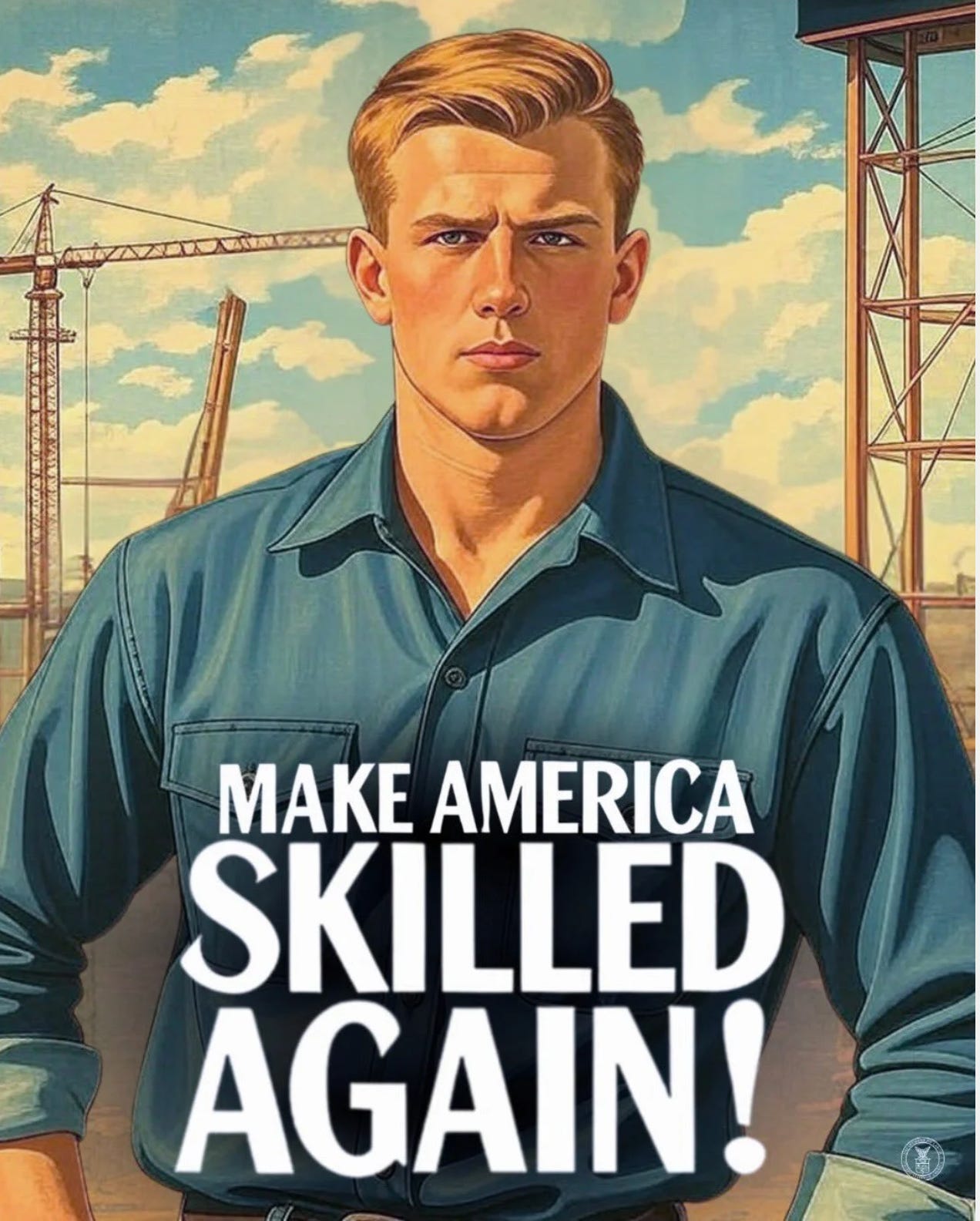
Let’s break it down:
The crane, scaffolding, and distant factory in the background of this image convey nondescript industry. This setting could be a construction site, an oil rig, a ready-mix plant, or any of a dozen other locations.
The words, “Make America Skilled Again!,” imply that in these sorts of settings there is a lack of skill.
We are to assume that the man in the foreground represents the skill that is needed. He, too, is nondescript. He’s not wearing a hard hat with a union sticker that reveals his trade, or a high vis vest with the name of a company, or holding a tool specific to his area of expertise.
He’s very clean to have the sort of job implied by the background. Maybe he just arrived to work.
Or maybe the crisp collared shirt and the lack of safety equipment imply that he’s the site manager. If so, he’s young for the position. He can’t be over twenty-five.
If this man is in a managerial role, he didn’t work his way into it. Trade school is two years minimum and many of the careers implied by this image’s nondescript background include long apprenticeships.
One inference we can make then is that someone in a position of power placed this clean young man with no signs of his trade and no safety equipment in a managerial position. Maybe his daddy owns the company behind him.
Or, since the image’s language is a variation on Make America Great Again, we could infer that the federal government somehow gave this young man his job.
When I pause to unpack this image, I deduce that the guy in this image is a tool. Likely, in the words of my working-class childhood, “he doesn’t know his ass from a hole in the ground.”
This leads to a second round of analysis:
What problems are we facing as Americans that this graphic exploits?
What solution does this graphic offer to that problem?
We’ll lean into these questions next week. In preparation, I want to leave you with another image. This picture is of some members of the Amalgamated Clothing Workers of America on strike at the Curlee Clothing Company in 1925:
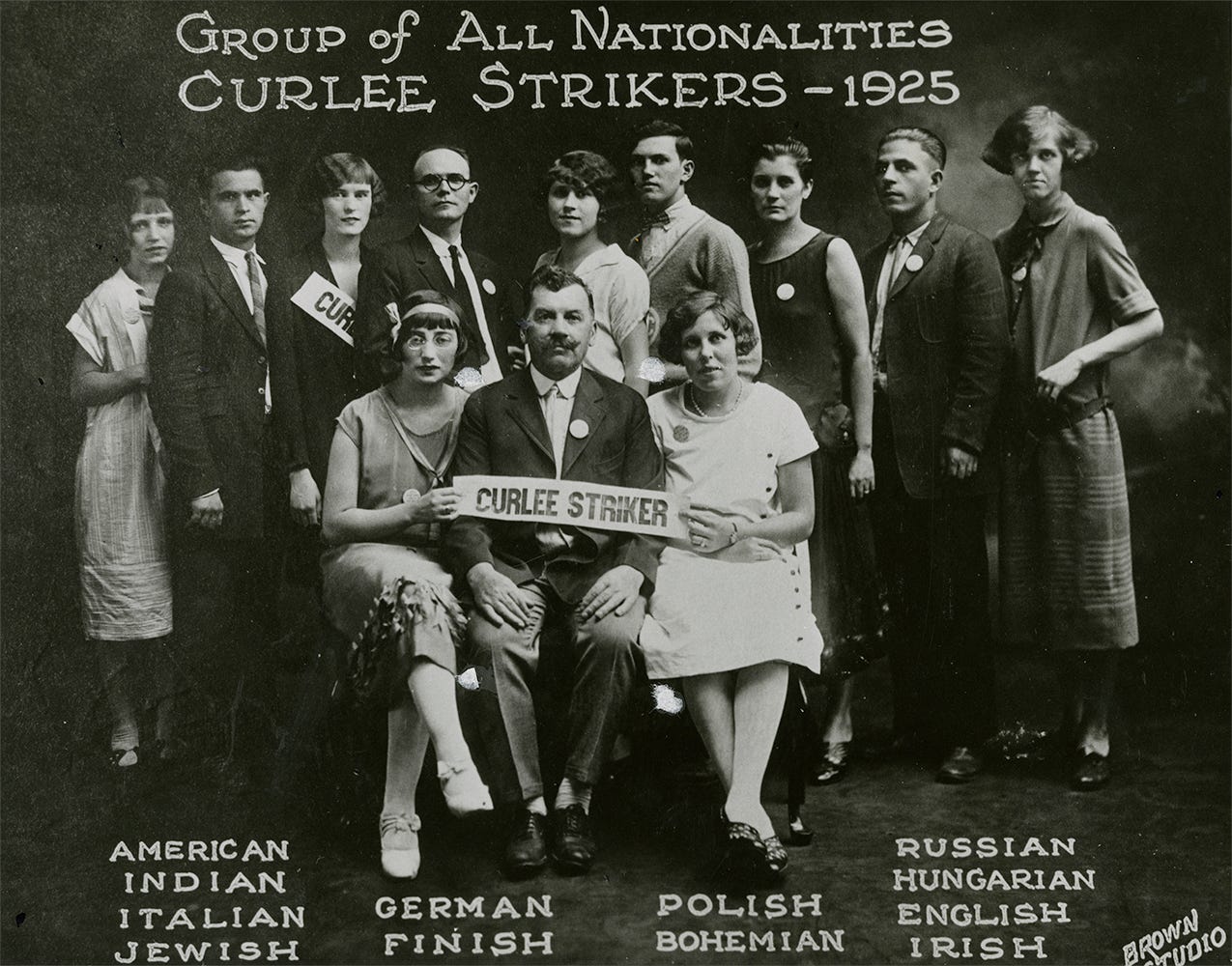
What’s implied by the text in this image? By the background? The people pictured? The clothing choices of the people pictured? How are the aims of this image different from the aims of the graphic of the squeaky-clean young white man in front of nondescript industry?
As to my qualifications, it’s true that I can’t repair your air conditioner, diagnose your heart condition, drive your tractor, or milk your cow. I’m a writer. But part of my skillset involves analyzing media and literature and presenting my analysis in plain language, just as I have done here. I have an undergraduate degree in Secondary English Education and a Master’s of Fine Arts in Writing and Literature. I’ve taught composition, creative writing, and literature courses at Georgia Military College and Southern New Hampshire University. I’ve published essays, short fiction, book reviews, and a novel. I currently work as a developmental editor helping other writers see their projects to completion. My work, like yours, has taken years to master and still I work at it daily. This newsletter is an example of my skilled labor.
This week’s tough love thought comes from 16th president of the United States, Abraham Lincoln: “If any man tells you he loves America, yet hates labor, he is a liar. If any man tells you he trusts America, yet fears labor, he is a fool.”
Until next week,
ginger
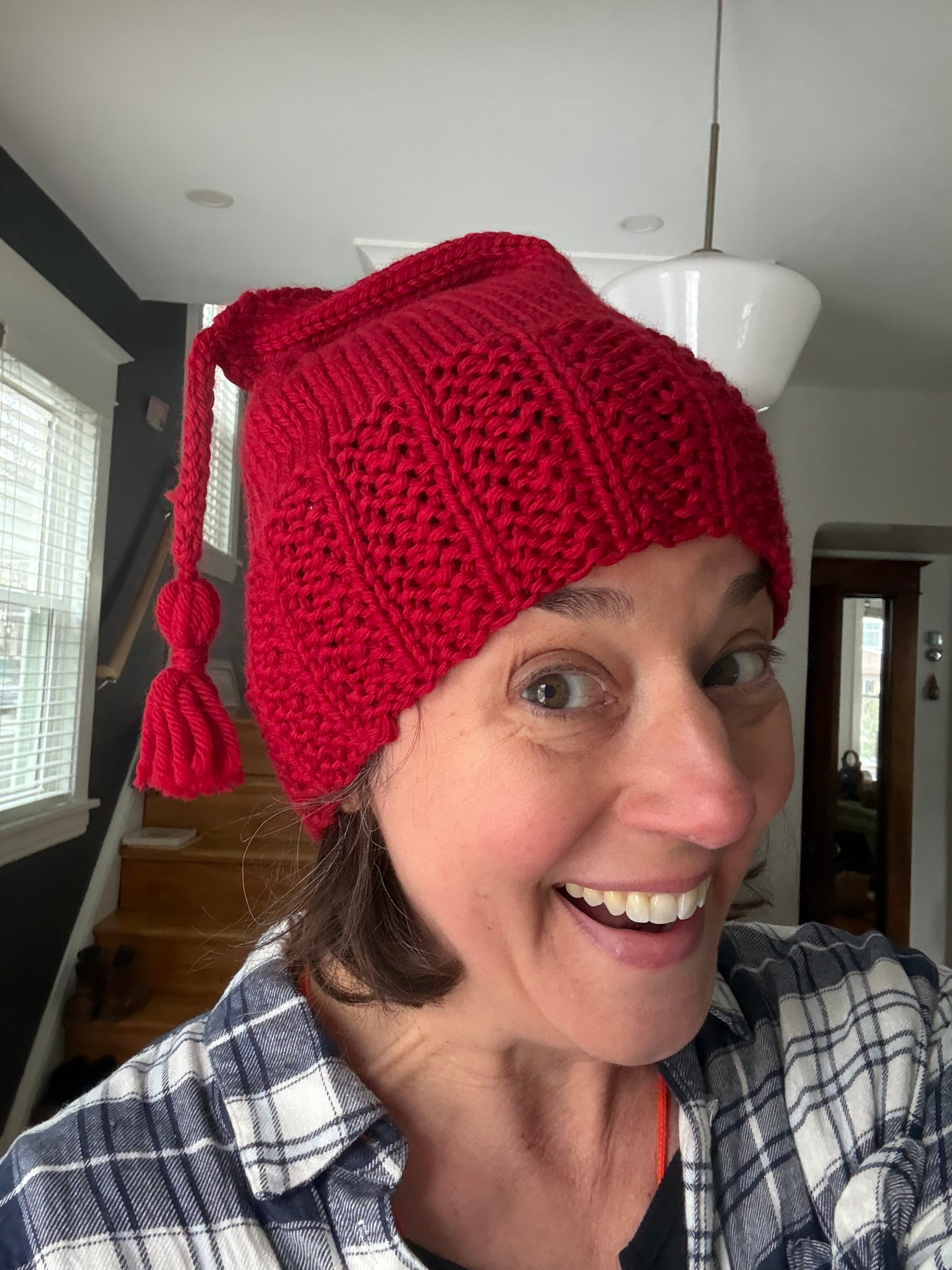
ps: Because the algorithms love a face, here’s a shot of me in my new resistance hat. A neighbor knitted it. More skilled labor someone else provided!
Such an excellent lesson in decoding propaganda. A great example of why English teachers are so important in a society. And thank you for your ongoing bravery in discussing this topic and for the heart with which you write.
I hear your voice in your writing, and feel your genuine care for all. You're pretty spectacular, my friend and I am fortunate to call you that.