
For the Helpers, 1.3
That's you by the way.

Dear KTC,
Welcome to those of you who are new here. I appreciate you showing up and helping out.
Stick to the first half of this letter if you’re having a tough week. Read the second half if you’re feeling well resourced.
Please use this as a tool to strengthen and build your communities.
I love you all so much.
The Easier Stuff
Here are three ways to help this week:
1. From your phone
Last week we compared calling our elected officials to casting a straw ballot on a particular issue. You may not even speak with a living person when you call, but your aye or nay message will be tallied. Numbers matter.
One of the easiest ways to have your opinion tallied at the national level is through 5 Calls. The website couldn’t be simpler. You enter your zip code, pick your cause, and you’re given links to call your senators and representative(s). There’s even a script to read aloud.
As I write to you, there are 44 issues set up for one-click calling. These range from defunding ICE to protecting the Boundary Waters Canoe Area Wilderness. The next time you feel like locking yourself in the bathroom and silent screaming, give 5 Calls a whirl.
2. With your wallet
The public giving opportunity that I share here will always be with an established group that has been forward facing since before federal occupation began. Such organizations are set up to easily receive and process payments. They offer tax compliant donation receipts. They also have more experience existing in the public eye and so, one hopes, they’re a bit safer from harassment.
If you and I know one another in real life and you’d rather give to a person or group involved in immediate fund dispersement, please message me. Currently, I can connect you to folks providing direct assistance to families in Minnesota, and I can connect you to people doing similar work in Georgia. Madison County, Georgia, has been heavily targeted by ICE. There are many families there who need assistance with rent, utilities, food, supplies, and legal aid.
Last week, I received an email from my vet here in Minnesota asking for donations of pet supplies or monetary gifts to The Bond Between. Pets are abandoned when people are abducted. Pets are surrendered when people are unable to meet an animal’s care needs. Shelters are filling fast in Minnesota. The Bond Between describes itself as an “animal well-being organization” because it does so much more than foster animals. TBB offers respite foster care, vet services, a pet food shelf, hospice care, and more. You can donate here.
3. With your kids
As a middle-aged woman, I often sit with friends who laugh about having been raised on Free to Be . . . You and Me. Usually the story involves someone’s mother assuring them that they can dress however they’d like, play with any toys they’d like, go to any college they’d like, have any job they’d like, and never get married. Not infrequently these mothers were divorced and going back to school in their thirties. Their children were raising themselves on Tab, Hot Pockets, and MTV. It was messy all around, as childhood and liberation always are.
I watched Free to Be . . . You and Me for the first time recently. It’s dated. But it also clearly arose from the recognition that life is a joint liberation project. As Fannie Lou Hamer, co-founder of the Mississippi Freedom Democratic party, said, “Nobody’s free until everybody’s free.”
My wish is for all humans who are currently children to become adults who laugh about their caregivers’ earnest efforts to raise kind, free, brave, open-hearted, self-confident little beings. Here’s a list of books that, with any luck, our kids will one day find terribly dated because the beliefs in them have become commonplace.
This week’s joyful thought was offered by a neighbor during a moment of confusion about who should be where when and how: “It’s muddy out here in the grassroots.”
The Tougher Stuff
1. Preparing your community
Keeping dollars local!
Let’s gameify keeping as much money as possible in local circulation and out of the pockets of unhelpful corporations like Target.
Like me, I bet you already know where your independent bookshops and artist co-ops are.
How local can you go in your grocery shopping? Last week two different friends told me that they are now doing a large part of their weekly shopping at a fourth-generation Mexican-owned grocery.
I’ve always loved indie beauty supply shops. There’s a great one near my house here in St. Paul. There I not only find items I might otherwise buy at a place like Sephora (rice blotting papers, anyone?), but there are also fun stationery items, socks, scarves and hair bobs.
When I lived in Georgia, a small printer repair shop refilled my printer cartridges. This kept my cartridges out of the landfill, saved me money, and kept my money local. This shop was located directly next door to a Best Buy. I found out about the service when I popped in to see if they could help me after Best Buy quit carrying my cartridges.
The small tire shop near my house in Georgia patched more tires of mine than I care to admit. This too was a lucky discovery. I couldn’t afford the new tire that had been recommended to me by the large shop, so I popped into this bright orange place I’d driven by dozens of times. They solved my problem in less than ten minutes. My tire was kept out of the landfill, I saved money, and my money stayed local. Also, my young son and the owner bonded over their shared affection for a Nigerian soccer player and this remained at the heart of my conversations each time I visited—”How is your son? Is he still playing football?”
We’ve all heard that we vote with our dollars. In order to vote with our dollars, we vote first with our attention, our time, and our curiosity. We have to notice the little shop, take the time to visit, see what they have on offer, ask if they’re soccer fans.
Now that your Signal group is going strong, you can easily share your amazing discoveries or ask others if they’ve found a good source for this or that. Maybe your friends would like to buy a pound or two of rice out of the twenty-five pound bag that you can get for such an amazing price at the Thai-owned grocery. (And if you’re in Decatur and know the grocery I’m referring to, I highly recommend their locally made kimchee and their adorable ceramic bowl collection.)
2. Seeking defectors
Many readers of this newsletter either voted for our current president or are members of politically diverse families and communities.
This week, let’s start a discussion about news sources. This is a big issue, so we’ll visit it more than once.
For a few years in my late twenties I lived in northeastern Nevada. Ranching and mining were the major employers in that region. This was during Bill Clinton’s second term, and locals often referenced Clinton threatening to fire half of the cattle guards in Nevada. Sometimes this was delivered as a joke and sometimes this was delivered as fact. Regardless of whether or not people truly believed that Clinton thought a cattle guard looked like this—

—the fact that this joke persisted tell us something true: national politics often feel quite distant from our daily lives.
The solution isn’t a national policy that decides on a national norm and then sets out to enforce it. Rather, we want a national policy flexible enough to account for all of the ways people live in America. Some of us are ranchers who encounter cattle guards several times a day, and some of us have never seen a cattle guard but can find our way across a city on public transit without once looking at a map.
All of us, no matter where we live, need healthcare, housing, food, and access to education. We all deserve to feel safe in our homes and in our communities. We all need clean air and clean water and access to green spaces.
When our primary news sources focus on national and international news, we lose sight of what’s happening right outside our own front door. When we don’t understand our own neighborhood, we lose our power to influence the government.
Political power in America is sort of like this screenshot of a book brigade relocating a bookstore from one storefront to another.
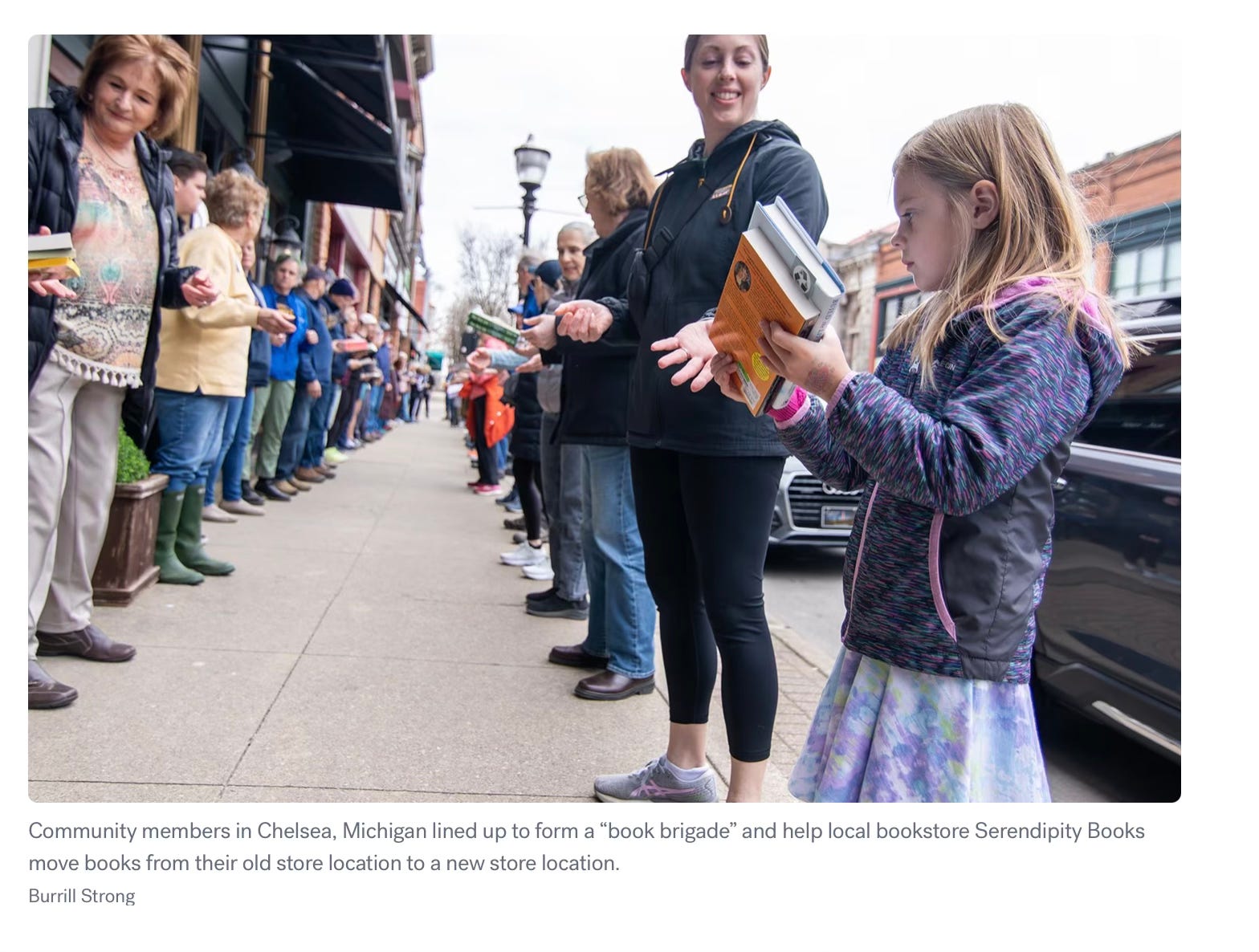
Each person passed the story they held on to the next and eventually the bookstore was filled. Similarly, we let our commissioner know how we feel so that they can inform our mayor, who will speak with our governor, who will speak with our president.
If we stay inside of our homes watching reels about the books that someone has tried to ban in that bookstore, then we’re not in the line of power at all. To be a part of it, we have to find a point of entry, be it passing along books, bringing water to the book passers, picking up the books that are dropped, playing music to keep the passers inspired, buying books from the bookstore on its grand re-opening day, or some role as yet unimagined.
All of which brings us back to the importance of local news. Local news sources clue us in to the gifts and challenges of our community. Start with your state’s paper and then go smaller. Does your county have a paper? Your city? Is there a paper for the LGBTQIA community? The Muslim community? The Indigenous community? The veteran community? You can look for these online, and you can also often find them at the exit doors of grocery stores. Better yet, go to your nearest library and ask them to show you local news sources.
Who are your neighbors? What are their concerns? How do your neighbors feel your community could be stronger? In what ways do you agree or disagree? How do you feel your community be stronger? How can you work with your neighbors toward shared goals for your community? How can you pass these messages along to elected officials?
Local news sources help us form opinions that arise from the reality of our everyday existence. If we’re not working to inform ourselves in these ways, we leave ourselves open to manipulation. Authoritarian regimes want us to stay inside of our houses and do as we’re told. They don’t want us to check in on our neighbors or to get to know our larger community. They don’t want us to unplug from the terrifying, state-sanctioned news sources and ask, “What evidence do I see on my streets that what I’m being told is true?”
I also find it helpful to look at local news sources for help understanding national stories that catch my attention. If you’re interested in the local take on the federal occupation of Minnesota, here’s a list of sources compiled by our friends at Stand with Minnesota.
This week’s tough love thought comes from the piece written on January 27th in The Atlantic by Adam Serwer, “Minnesota Proved MAGA Wrong.” Not a local paper, but a fine quote nonetheless: “The secret fear of the morally depraved is that virtue is actually common, and that they’re the ones who are alone.”
Until next week,
ginger
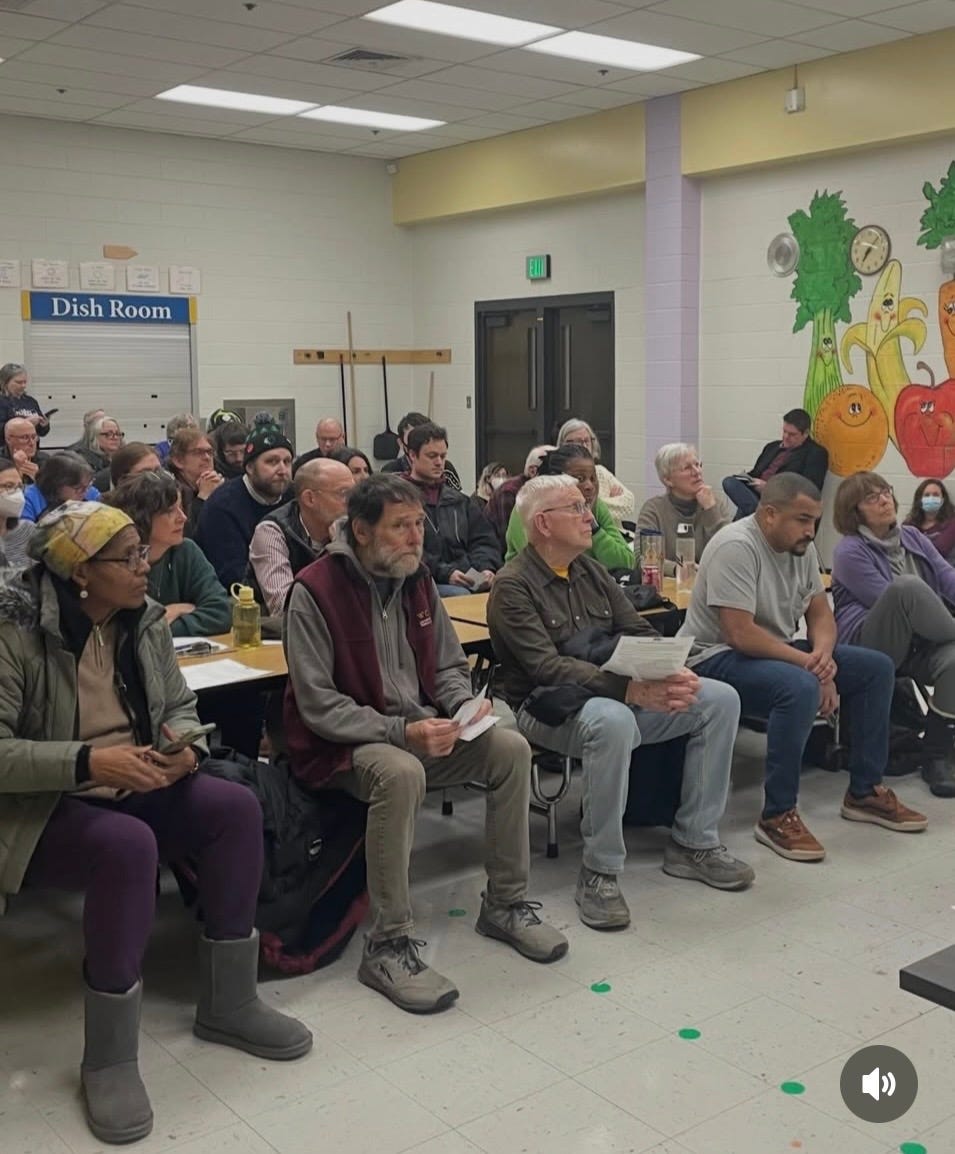
ps: Because the algorithms love a face, here’s a screenshot of my local caucus meeting. Glamorous, right? I lifted it from Senator Erin Murphy’s instagram. See if you can find me. This was my first caucus, and I signed up to be a delegate. Trying to get in that book brigade, y’all! I’m not writing anything that I don’t also need to hear.
Ginger, this is just what I needed. Thank you!
I love the recommended books!!!! And every thing else.